
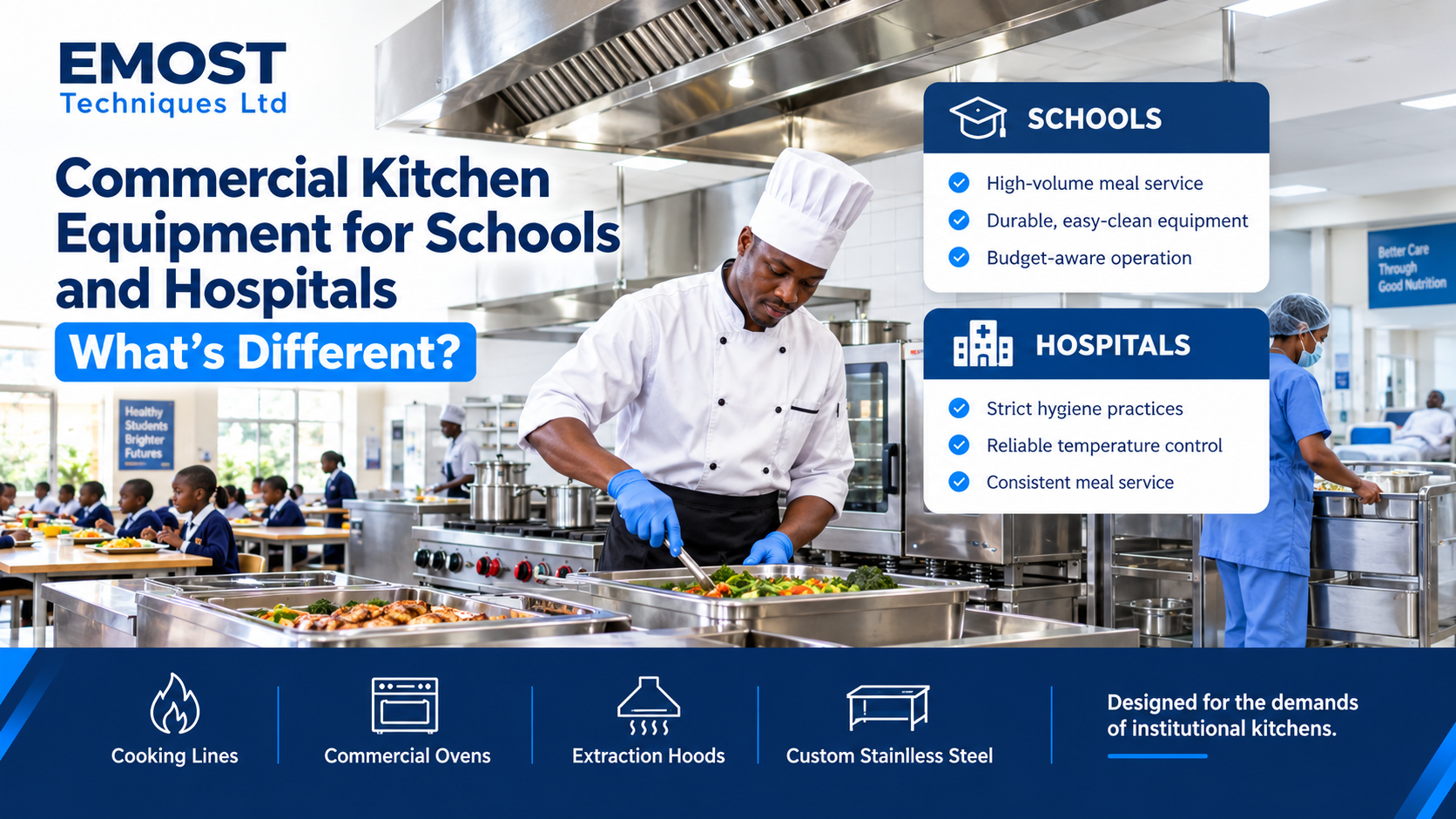
Schools and hospitals need institutional kitchen equipment in Kenya that can handle large quantities of food consistently, safely and efficiently. Unlike many restaurants, institutional kitchens often prepare meals according to fixed schedules, serve large numbers of people at once and need equipment that can withstand repetitive daily use.
A hospital kitchen also has additional operational considerations around special diets, food hygiene, controlled preparation and service to patients and staff. A school kitchen may instead prioritize high-volume batch cooking, simple workflows and rapid meal distribution.
The key difference is this:
Institutional kitchen equipment is selected around production volume, consistency, hygiene and reliability—not just menu variety.
What makes institutional kitchen equipment different from restaurant equipment?
Institutional kitchen equipment is generally selected for sustained batch production and repetitive use rather than primarily for à la carte cooking.
A typical restaurant may prepare individual meals continuously throughout service.
A school or hospital may need to prepare hundreds of portions within a defined production window.
That changes the equipment requirements.
| Restaurant kitchen | Institutional kitchen |
|---|---|
| More à la carte production | More batch production |
| Flexible menu | Often structured menus |
| Smaller production batches | Large production batches |
| Rapid individual order response | Scheduled meal production |
| Equipment may be specialized | Equipment often prioritizes capacity and durability |
| Service spread across a period | Large volumes may be served within a short window |
This does not mean institutional kitchens never need specialized equipment.
It means the equipment schedule should be designed around the institution's production system.
What equipment does a school or hospital kitchen need?
The exact equipment list depends on the institution, menu and number of meals produced, but a full institutional kitchen can include:
- Heavy-duty cooking ranges
- Commercial ovens
- Multi-deck or convection ovens
- Large-capacity boiling pans
- Tilting pans
- Bain-marie units
- Commercial deep fryers
- Griddles
- Steamers
- Food preparation tables
- Vegetable preparation equipment
- Meat preparation equipment
- Refrigerators
- Freezers
- Cold rooms
- Pot wash stations
- Dishwashers
- Stainless-steel sinks
- Storage shelving
- Food holding equipment
- Trolleys
- Serving counters
- Extraction hoods
- Grease filters
- Kitchen ventilation systems
A small school may require only a fraction of this list.
A large boarding school, university, hospital or central production facility may require several high-capacity cooking and preparation systems.
How should institutional kitchens be sized?
Institutional kitchen equipment should be sized according to the number of meals, batch sizes and peak production periods.
The first calculation should therefore not be:
"How big is the kitchen?"
It should be:
"How many portions must the kitchen produce, and within what time?"
For example, assume a school needs to prepare 600 lunches.
If the kitchen needs to complete major cooking within two hours, the equipment must support a significantly higher production rate than a kitchen preparing the same 600 portions over six hours.
A useful planning framework is:
Number of portions × portion size × production window = required production capacity
The actual equipment capacity then depends on the product and cooking process.
For bulk cooking, this may involve calculating the required capacity of:
- Cooking pans
- Pots
- Steamers
- Ovens
- Fryers
- Preparation machines
- Holding equipment
This is why institutional kitchen design starts with a production schedule, not simply an equipment catalogue.
What is the difference between school kitchen equipment and hospital kitchen equipment?
School kitchens primarily focus on high-volume meal production, while hospital kitchens generally require greater attention to food segregation, special diets, hygiene controls and controlled meal distribution.
A school kitchen might be optimized for producing:
- Ugali
- Rice
- Beans
- Vegetables
- Stews
- Tea
- Porridge
- Fried foods
- Bread or baked products
The emphasis is often on batch production and serving large groups efficiently.
A hospital kitchen may need to support:
- Standard patient meals
- Modified-texture diets
- Therapeutic diets
- Special dietary requirements
- Staff meals
- Visitor meals, depending on the facility
The equipment requirements can therefore be different even when both facilities serve a similar number of people.
Why is food flow important in an institutional kitchen?
Food flow is critical because large-scale production increases the consequences of a poorly organized workflow.
A typical institutional production sequence may be:
Receiving → Storage → Preparation → Cooking → Holding → Portioning → Distribution → Dishwashing
The layout should reduce unnecessary crossing between raw ingredients, cooked food, dirty equipment, waste and clean utensils.
The Codex General Principles of Food Hygiene emphasize hygienic design, layout and separation where necessary to minimize contamination and permit effective cleaning and maintenance. (fao.org)
For institutional kitchens, good workflow also improves productivity.
A cook should not need to carry a 50-litre pot across the entire kitchen because the cooking line was positioned too far from the preparation area.
A cleaner should not have to push dirty trolleys through a clean meal-plating zone.
The layout has to work at institutional scale.
Why are batch cooking appliances important for schools?
Batch cooking equipment can significantly improve efficiency in schools because it allows large quantities of food to be prepared at once.
Instead of cooking dozens of small pots individually, an institutional kitchen can use larger-capacity equipment designed for bulk production.
Depending on the menu, this may include:
- Large boiling pans
- Steam-jacketed kettles
- Tilting frying pans
- Bulk ovens
- Steamers
- Large-capacity rice cookers
The right equipment depends on the menu.
For example, a school serving large volumes of beans may benefit from high-capacity boiling equipment, while a bakery-focused institution may require much greater oven capacity.
The important principle is:
Choose the appliance around the food-production task, not around what happens to be available in a catalogue.
How much cooking capacity does a hospital kitchen need?
Hospital kitchen capacity should be based on the facility's meal-production model, patient population, staff meals and peak service requirements.
A hospital may operate differently from a restaurant because meals can be prepared centrally and then distributed to wards.
This creates additional equipment considerations around:
- Hot holding
- Cold holding
- Portioning
- Meal assembly
- Trolley movement
- Service timing
- Dietary separation
- Dish return
The equipment therefore has to support the entire meal cycle, not just cooking.
A high-capacity oven is of limited value if the kitchen has no efficient way to hold and distribute the food after cooking.
Why is food holding equipment important in institutional kitchens?
Food holding equipment bridges the gap between production and service.
Schools and hospitals may need to prepare food before the exact moment it is served, making hot and cold holding an important part of the kitchen system.
Common equipment can include:
- Bain-maries
- Hot cupboards
- Heated holding cabinets
- Refrigerated preparation counters
- Cold storage
- Insulated food transport equipment
WHO's food-safety guidance emphasizes keeping food at safe temperatures and preventing contamination between raw and prepared foods. (who.int)
The holding stage should therefore be considered when determining the equipment schedule.
Why does equipment durability matter more in institutional kitchens?
Institutional kitchens can place equipment under heavy repetitive loads, making durability and serviceability particularly important.
A school may run cooking equipment every weekday throughout the academic year.
A hospital may operate its kitchen every day, including weekends and public holidays.
Equipment should therefore be evaluated not only by purchase cost but also by:
- Construction quality
- Material quality
- Ease of cleaning
- Serviceability
- Spare-parts access
- Maintenance requirements
- Operator safety
- Expected workload
This is particularly important for a bulk kitchen equipment supplier because equipment failure can disrupt meal production for hundreds of people.
A cheaper appliance that repeatedly fails may become more expensive operationally than a better-built piece of equipment.
Why is stainless steel commonly used in institutional kitchens?
Stainless steel is widely used for commercial and institutional kitchen equipment because it provides a durable, cleanable surface suitable for professional food-service environments.
A school kitchen fabrication project may use stainless steel for:
- Work tables
- Preparation benches
- Sinks
- Shelving
- Storage units
- Serving counters
- Splashbacks
- Equipment stands
- Pot-washing stations
Kenya's Food Hygiene Regulations require food-contact surfaces to be smooth, free from pits and crevices, non-toxic, non-absorbent where applicable, and capable of withstanding repeated cleaning and sanitizing. The regulations also require equipment to be installed and maintained in a way that facilitates effective cleaning. (new.kenyalaw.org)
This makes hygienic fabrication more important than simply choosing equipment because it looks like stainless steel.
What is hygienic kitchen equipment design?
Hygienic kitchen equipment design means equipment is constructed and installed so that food contamination is minimized and cleaning, inspection and maintenance can be carried out effectively.
Important features include:
- Smooth food-contact surfaces
- Well-finished joints
- Minimized dirt traps
- Accessible cleaning areas
- Appropriate equipment clearances
- Proper drainage
- Suitable materials
- Correct installation
The practical test is simple:
Can staff clean the equipment properly every day?
If the answer is no, the design needs to be reconsidered.
Kenyan food-hygiene regulations specifically address the cleanability and installation of equipment, making these details relevant to institutional kitchen projects. new.kenyalaw.org
Why are sinks and washing areas different in hospitals and schools?
The washing area should be designed around the volume and type of items that need to be cleaned.
An institutional kitchen may process large numbers of:
- Cooking pots
- Trays
- Plates
- Cups
- Cutlery
- Food containers
- Serving utensils
A domestic-style sink is quickly overwhelmed by this workload.
Depending on the facility, the kitchen may require separate or dedicated areas for handwashing, food preparation washing, pot washing and dishwashing.
Kenya's Food Hygiene Regulations require suitable water supplies, handwashing provisions and drainage for food premises and require food-contact equipment and utensils to be cleaned and stored hygienically. new.kenyalaw.org
The wash-up area should therefore be sized according to actual daily throughput.
How does hospital food-service equipment support special diets?
Hospital kitchens may need equipment and work areas that support more controlled food preparation and diet-specific production.
The exact requirements depend on the hospital and its food-service system, but the layout may need to support clear identification and separation of ingredients or prepared meals.
This can influence:
- Refrigeration
- Preparation benches
- Storage
- Portioning areas
- Meal assembly
- Holding equipment
- Trolleys
- Labelling and distribution workflows
The important point is that the hospital kitchen should be designed around the facility's clinical and food-service workflow, rather than treating it as a larger restaurant kitchen.
What equipment does a boarding school kitchen need?
A boarding school kitchen usually needs equipment capable of producing large volumes of meals on a predictable schedule.
A typical equipment package may include:
Cooking
- Heavy-duty gas or electric ranges
- Large boiling pans
- Deep fryers
- Ovens
- Tilting pans
- Steamers
Preparation
- Stainless-steel work tables
- Vegetable preparation equipment
- Food processors where appropriate
- Cutting and preparation stations
Storage
- Commercial refrigerators
- Freezers
- Dry storage shelving
- Ingredient storage
Washing
- Large sinks
- Pot wash stations
- Dishwashing equipment
- Drainage systems
Service
- Bain-maries
- Hot holding cabinets
- Serving counters
- Food transport trolleys
The final equipment schedule should be calculated from the number of students, meal schedule, menu and kitchen operating hours.
What is the difference between institutional and commercial kitchen fabrication?
Institutional fabrication often involves larger-capacity workstations, heavier-duty construction and equipment designed around bulk production.
A standard restaurant may need a small preparation table.
A boarding school may need an extended preparation line designed for several cooks to work simultaneously.
A hospital may require custom storage and trolley interfaces.
Custom school kitchen fabrication therefore needs to account for both dimensions and workload.
Typical fabricated items can include:
| Fabricated item | Institutional design consideration |
|---|---|
| Preparation table | Number of operators and production volume |
| Sink unit | Washing volume and drainage |
| Pot-wash station | Large cooking vessels |
| Storage shelving | Bulk ingredient storage |
| Serving counter | Number of meals served |
| Equipment stands | Heavy appliances and cleaning access |
| Hot holding counter | Meal distribution |
| Wall shelving | Space efficiency |
How should institutional kitchen equipment be arranged?
Institutional equipment should be arranged around the production sequence and the people operating the kitchen.
A large kitchen still needs practical relationships between workstations.
For example:
Dry storage → Preparation → Cooking → Holding → Service
should involve as little unnecessary movement as possible.
Similarly:
Service → Dirty dish collection → Washing → Clean storage
should not interfere with food preparation.
This is where professional kitchen planning becomes particularly valuable.
Equipment can technically fit in a room and still create a poor kitchen.
The real test is whether staff can move ingredients, cookware and prepared meals efficiently during peak production.
What ventilation equipment do institutional kitchens need?
Institutional cooking areas that generate significant heat, smoke or grease-laden vapour require appropriate commercial extraction and ventilation.
The extraction system should be designed around the cooking equipment rather than simply installing a large fan.
The designer needs to consider:
- Cooking appliance type
- Hood dimensions
- Exhaust airflow
- Duct routing
- Make-up air
- Grease filtration
- Discharge location
- Fire safety requirements
The National Building Code, 2024 contains requirements relevant to ventilation in buildings, while commercial cooking exhaust also requires consideration of applicable fire-safety provisions and the specific equipment installation requirements. (new.kenyalaw.org)
For a large school or hospital kitchen, extraction should be coordinated during the building-design stage rather than added after equipment is installed.
Why is energy efficiency important in institutional kitchens?
Energy efficiency matters because institutional kitchens can operate equipment for many hours and at significant production loads.
The main opportunities often come from selecting equipment appropriate to actual demand and avoiding unnecessary idle capacity.
Consider:
- Oven capacity
- Fryer size
- Cooking time
- Heating system
- Refrigeration efficiency
- Hot holding
- Ventilation
- Equipment scheduling
Buying oversized equipment does not automatically improve efficiency.
In some cases, it simply means heating a larger system than necessary.
The better objective is to match equipment capacity to the kitchen's actual production profile.
How should a bulk kitchen equipment supplier approach an institutional project?
A bulk kitchen equipment supplier should approach the project as a complete kitchen system rather than a collection of individual appliances.
The supplier should understand:
- Number of meals
- Meal schedule
- Menu
- Production methods
- Kitchen dimensions
- Available utilities
- Storage requirements
- Washing requirements
- Distribution method
- Future expansion plans
This allows the supplier to create a coordinated equipment schedule.
For larger projects, this may involve CAD drawings, equipment schedules, stainless-steel fabrication, extraction systems, refrigeration and installation.
The value of a good supplier is therefore not simply supplying more equipment.
It is selecting the right equipment and making the pieces work together.
How should institutional kitchen projects be designed in Kenya?
Institutional kitchen projects in Kenya should be developed around the intended food operation, applicable food-hygiene requirements, building requirements and the specific needs of the institution.
The Food Hygiene Regulations include requirements covering premises, food-contact surfaces, equipment, water, drainage, handwashing, waste and general hygiene.
new.kenyalaw.org
The National Building Code, 2024 provides the current national building framework and includes provisions relevant to building services and ventilation. new.kenyalaw.org
For hospitals, schools and other institutions, the project may also have additional client, sector or facility-specific requirements.
The important point is to establish these requirements before fabrication begins.
A practical school kitchen equipment example
Imagine a boarding school serving 800 students.
The school requires breakfast, lunch and dinner every day.
The menu includes porridge, tea, rice, ugali, beans, vegetables, meat and occasional fried foods.
A suitable design process would begin by calculating:
Number of meals → menu → batch sizes → cooking times → production windows
The equipment might then include:
- Large boiling equipment for beans and porridge
- Heavy-duty ranges
- Large-capacity cooking pans
- Fryers
- Ovens
- Refrigeration
- Preparation tables
- Large sinks
- Pot washing
- Hot holding
- Serving equipment
The kitchen layout would then position these systems according to the school's workflow.
The objective is not to buy 800-person-capacity equipment merely because the school has 800 students.
The objective is to determine how much food must be produced at one time and how quickly it must move through the kitchen.
A practical hospital kitchen equipment example
Now consider a hospital serving meals to 300 patients and staff.
The kitchen may produce food centrally, portion individual meals and distribute them to wards.
The equipment plan therefore needs to account for:
Storage → Preparation → Cooking → Diet-specific preparation → Portioning → Holding → Trolley distribution → Dish return
This may require a stronger emphasis on holding, meal assembly, storage and controlled food flow than a conventional restaurant.
A cooking line designed without considering the distribution stage could create a bottleneck after production.
That is why institutional kitchen design must consider the entire process.
What are the biggest mistakes when selecting institutional kitchen equipment?
The biggest mistake is selecting equipment based on the number of people served without calculating how the kitchen actually produces and distributes their meals.
Other common mistakes include:
- Buying equipment before finalizing the menu
- Underestimating peak production
- Ignoring utility requirements
- Choosing domestic equipment for institutional workloads
- Leaving insufficient cleaning access
- Poorly positioning wash-up areas
- Ignoring extraction requirements
- Failing to plan food holding
- Treating fabrication as separate from kitchen design
- Ignoring future expansion
A kitchen can have expensive equipment and still be inefficient if the equipment is poorly coordinated.
What should institutions ask before buying kitchen equipment?
Before placing an order, the project team should be able to answer:
How many meals are produced per service?
How quickly must they be produced?
Which foods are prepared in bulk?
Which equipment creates the production bottleneck?
Where are raw ingredients stored?
How is cooked food held?
How is food distributed?
How are dirty utensils returned and washed?
What utilities are available?
What equipment needs custom fabrication?
These answers create the foundation for an appropriate equipment schedule.
The real difference: institutional kitchens are production systems
The biggest difference between institutional and conventional restaurant kitchens is the scale and predictability of the production workflow.
Schools and hospitals are not simply restaurants with more seats.
Their kitchens often need to produce large quantities of food on a schedule, maintain consistent standards, support hygiene controls and move meals efficiently from storage to preparation, cooking, holding and service.
That is why the equipment should be selected as a connected system:
Production requirements → Kitchen layout → Equipment capacity → Fabrication → Utilities → Installation → Commissioning
For institutional kitchen equipment in Kenya, this approach is more reliable than selecting appliances individually from a catalogue.
A properly designed institutional kitchen should make large-scale food production more predictable, hygienic and manageable for the people who operate it every day.
Common Questions
Planning a commercial kitchen or bakery?
EMOST fabricates and installs complete commercial kitchens across Kenya — from deck ovens and prep tables to extraction hoods and full cooking lines. Get an itemized quote before you order.