
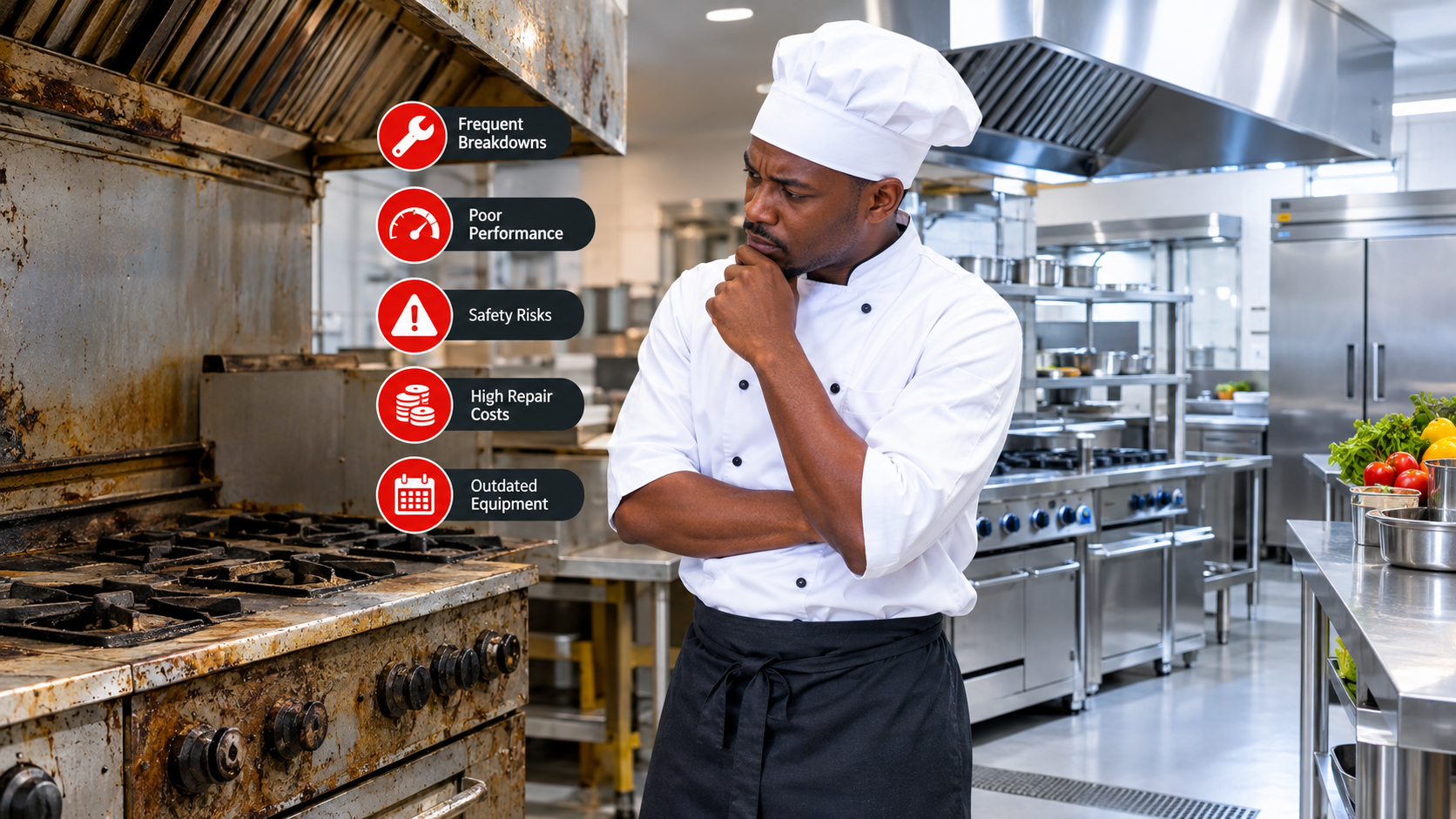
Knowing when to replace commercial kitchen equipment is not simply a question of age. A fryer, oven, refrigerator or dishwasher may continue operating for years, but repeated breakdowns, rising operating costs, poor performance, safety problems and difficulty finding parts can make continued repairs a poor business decision.
There is no universal lifespan that applies to every commercial appliance. Usage intensity, maintenance, equipment quality and operating conditions all affect service life. The better approach is to evaluate the equipment's total cost of ownership and its ability to do the job reliably. ENERGY STAR specifically recommends considering purchase price together with long-term energy and operating costs when replacing aging commercial kitchen equipment.
When should you replace commercial kitchen equipment instead of repairing it?
You should consider replacing equipment when repairs are becoming frequent or expensive, performance is deteriorating, energy consumption is increasing, parts are difficult to obtain, or the equipment no longer meets the kitchen's operational requirements.
A repair makes sense when it restores reliable performance at a reasonable cost. Replacement becomes more attractive when the equipment repeatedly returns to the same problem or several different components are beginning to fail.
The decision can be simplified into five questions:
- Is it reliable?
- Is it safe?
- Is it efficient?
- Is it still suitable for the kitchen's workload?
- Is repairing it still economically sensible?
If several answers are no, replacement deserves serious consideration.
Is there a standard commercial kitchen equipment lifespan?
No single lifespan applies to all commercial kitchen equipment.
A commercial fryer, refrigerator, oven, dishwasher and stainless-steel fabrication unit experience very different operating conditions. A piece of equipment running continuously in a busy hotel kitchen may experience substantially more wear than the same model used intermittently in a small café. This is why a fixed rule such as "replace every five years" is too simplistic.
Instead, commercial kitchen equipment lifespan should be treated as a range influenced by workload, maintenance, construction quality, environment and availability of service support. Age is a useful warning signal, but it should not be the only replacement criterion.
What are the biggest signs that commercial kitchen equipment needs replacing?
The strongest warning signs are repeated breakdowns, declining performance, excessive energy use, safety concerns and the increasing difficulty of keeping the equipment operational. Look for these symptoms:
- Frequent breakdowns
- Multiple repairs within a short period
- Increasing repair costs
- Long periods of downtime
- Inconsistent cooking temperatures
- Poor refrigeration performance
- Excessive energy or water consumption
- Corrosion or structural deterioration
- Broken controls that are difficult to replace
- Obsolete technology
- Parts that are no longer readily available
- Equipment that no longer matches production demand
One problem alone may justify a repair. Several problems occurring together often indicate that the equipment has reached the point where replacement should be evaluated.
How do frequent breakdowns indicate that equipment should be replaced?
Frequent breakdowns are one of the clearest signs that replacement may make more sense than continued repair. Consider an oven that experiences one minor thermostat issue after years of otherwise reliable operation — repairing it is straightforward. Now compare that with an oven that has experienced repeated thermostat failures, door problems, heating-element faults and control-board issues. Each repair may be individually reasonable, but together they point to a deteriorating asset.
The important question is not "Can this component be repaired?" It is "How many more failures are we realistically buying by repairing it?" That shift in thinking leads to better equipment decisions.
How do repair costs compare with replacement costs?
Replacement should be considered when accumulated repair and operating costs begin to approach the cost of a reliable replacement. However, there is no universal percentage that determines when replacement is correct. Instead, calculate the full economic picture:
Recent repair costs + expected future repairs + downtime + energy costs + lost production = true cost of keeping the equipment
This matters because the invoice from the technician is only one part of the cost. Imagine a restaurant fryer repeatedly shutting down during lunch service. The repair bill may be manageable, but the business may also lose sales, delay orders and force staff to use less efficient backup equipment. Those indirect costs can make repeated repair much more expensive than it appears.
When does equipment downtime become a replacement issue?
Downtime becomes a replacement issue when an appliance repeatedly interrupts the kitchen's production schedule. One failed refrigerator can affect food storage. One failed fryer can disrupt an entire fried-food menu. One failed oven can delay bakery production. One failed dishwasher can create a backlog of dirty utensils and cookware. The more critical the equipment is to the operation, the more expensive downtime becomes — so a less expensive repair may still be the wrong decision if the equipment has become unreliable.
Can rising energy bills indicate aging kitchen equipment?
Yes. Rising energy consumption can be a sign that equipment has become less efficient, although the cause should be diagnosed before assuming the appliance needs replacement. ENERGY STAR notes that commercial kitchen equipment can become less efficient over time and specifically recommends checking and recalibrating thermostats and controls. An oven operating at the wrong temperature may consume more energy while still producing inconsistent food; a refrigerator with a poorly sealing gasket can lose cold air continuously. If maintenance, calibration or adjustment no longer solves the problem, replacement becomes more compelling.
When should you replace a commercial refrigerator?
A commercial refrigerator should be considered for replacement when it cannot consistently maintain required operating conditions, requires frequent repairs, has significant deterioration or has become unusually expensive to operate. Warning signs can include:
- Frequent compressor problems
- Inconsistent internal temperature
- Excessive frost
- Damaged or poorly sealing door gaskets
- Repeated refrigerant or cooling-system problems
- Corrosion
- Door or hinge damage
- Frequent service calls
- Increasing operating costs
That illustrates an important distinction: a worn gasket is usually a repair problem, while a refrigerator with failing core components and repeated repairs may be a replacement problem.
When should you replace a commercial oven?
A commercial oven may need replacement when temperature control becomes unreliable, heating performance deteriorates, major components repeatedly fail or the oven no longer provides the capacity the kitchen requires. Common warning signs include:
- Uneven cooking
- Slow preheating
- Temperature fluctuations
- Door-seal problems
- Failed heating elements
- Faulty control systems
- Repeated electrical or gas-related issues
- Excessive heat escaping from the chamber
The replacement decision should come after determining whether the problem is a serviceable calibration or component issue — or evidence of broader deterioration.
When should you replace a commercial fryer?
A commercial fryer should be evaluated for replacement when it can no longer maintain reliable temperature control, develops recurring leaks or heating faults, becomes difficult to service or no longer provides enough production capacity. Warning signs include slow temperature recovery, unstable oil temperature, repeated thermostat failures, damaged controls, oil leaks, serious corrosion, drain-valve problems and insufficient capacity for the current menu. A fryer that technically works but cannot recover temperature fast enough during peak service is a business problem — the equipment has not necessarily broken; it has simply become inadequate for the kitchen's current workload.
When should you replace a commercial dishwasher?
A commercial dishwasher should be considered for replacement when wash performance deteriorates, cycles become excessively long, breakdowns become frequent or water and energy consumption are no longer economical. A dishwasher that requires staff to rewash plates manually is not functioning efficiently even if the machine technically completes a cycle. For high-volume kitchens, labour and throughput should be included when evaluating replacement.
What does corrosion tell you about commercial kitchen equipment?
Corrosion can range from a cosmetic problem to evidence of serious structural deterioration. Surface marks on stainless steel do not automatically mean an appliance needs replacement. However, deeper corrosion can affect structural integrity, food-contact surfaces, welds, cabinet construction, door frames, legs and supports, and drainage areas. Where corrosion is extensive or repeatedly returning because of underlying damage, replacement may be more appropriate than cosmetic repair.
When does obsolete equipment justify replacement?
Equipment can become obsolete before it becomes completely unusable. Older controls may be less precise, older refrigeration systems may be inefficient, and newer cooking equipment may provide better automation, simpler cleaning or monitoring, and a better match to the kitchen's current production requirements. The important consideration is whether the upgrade provides enough operational value to justify replacing equipment that still technically works.
What if replacement parts are difficult to find?
Difficulty obtaining replacement parts is a major warning sign. A machine can be mechanically sound but operationally risky if a failed component takes weeks to source — particularly for critical equipment such as refrigeration, ovens, fryers, dishwashers, ice machines and steam equipment. Before deciding to keep repairing an older appliance, ask whether parts can still be sourced reliably, how long service normally takes, whether qualified technicians are available, and whether the manufacturer still supports the model.
How does increased kitchen demand justify equipment replacement?
Equipment does not have to be broken to be replaced. A restaurant can outgrow perfectly functional equipment — a café that once sold 50 meals per day may eventually sell 200. The original refrigerator, fryer, oven or preparation equipment may technically still operate, but it has become a bottleneck. The correct question becomes "Does this equipment still meet today's production requirements?" — not "Does this equipment still switch on?"
How can restaurant equipment upgrades improve productivity in Kenya?
A restaurant equipment upgrade in Kenya can improve productivity when new equipment addresses a genuine operational constraint. Potential improvements include:
- Faster cooking
- Better temperature consistency
- Larger batch capacity
- Faster refrigeration recovery
- Reduced washing time
- Better workflow
- Lower energy consumption
- Improved staff productivity
For Kenyan businesses, the financial case should be evaluated using the site's actual energy costs, utility conditions, workload and equipment prices rather than assuming a particular savings percentage.
How do you know whether to repair or replace commercial kitchen equipment?
Use a structured repair-versus-replace assessment instead of making the decision based on emotion or the most recent breakdown.
| Question | Repair may make sense | Replacement deserves consideration |
|---|---|---|
| Frequency of failure | Occasional | Repeated |
| Repair cost | Low and predictable | Increasing |
| Parts | Readily available | Difficult or obsolete |
| Performance | Restored reliably | Continues declining |
| Energy use | Acceptable | Increasing |
| Safety | No major concerns | Persistent concerns |
| Capacity | Meets current demand | Production bottleneck |
| Downtime | Minimal | Disruptive |
| Construction | Sound | Corroded or deteriorated |
| Future needs | Still suitable | Clearly undersized |
This framework is more useful than applying an arbitrary equipment-age rule.
Should you replace equipment before it completely fails?
Sometimes, yes. Planned replacement can be more economical than emergency replacement when a critical appliance is already showing multiple warning signs. Emergency failures create urgent purchasing decisions, limited equipment choice, production disruption, temporary workarounds, installation pressure and potential lost revenue. A planned replacement allows the business to compare specifications, dimensions, utility requirements and installation options before committing.
What is total cost of ownership for commercial kitchen equipment?
Total cost of ownership includes far more than the original purchase price. A useful model is:
Purchase cost + installation + energy + water + maintenance + repairs + downtime + eventual replacement
This explains why the cheapest equipment is not necessarily the cheapest equipment to own. For a busy commercial kitchen, reliability can be worth more than a small difference in initial purchase price.
How should Kenyan restaurants approach commercial kitchen equipment replacement?
Restaurants in Kenya should evaluate replacement decisions based on workload, operating costs, service support, equipment condition and the availability of suitable replacement units. A practical process is:
- Identify critical equipment — determine which appliances would seriously disrupt operations if they failed.
- Review repair history — look at the number, type and cost of recent repairs.
- Check current performance — measure temperature consistency, production capacity and energy use.
- Assess future requirements — determine whether the equipment still matches the menu and expected demand.
- Compare replacement options — compare the current machine's total operating cost with suitable modern alternatives.
- Plan the installation — confirm dimensions, electrical supply, gas requirements, drainage, ventilation and access before ordering.
Replacement is much safer when treated as a kitchen-design decision, not just a purchasing decision. Our commercial kitchen equipment fabrication service covers exactly that — sizing, fabrication and installation together — and our commercial kitchen equipment checklist walks through the full procurement order for a new setup.
What are the signs that an entire kitchen needs upgrading?
Sometimes the problem is not one appliance. Several aging units may indicate that the kitchen as a whole has reached the end of an equipment cycle — old refrigeration, outdated cooking equipment, poor extraction, inadequate preparation space, repeated failures, high energy use, increasing maintenance costs and insufficient production capacity occurring together. Installing a higher-capacity fryer may require a different extraction hood; replacing ovens may require electrical upgrades; increasing refrigeration may affect available floor space. A coordinated kitchen equipment upgrade can address these relationships properly.
Why should replacement equipment be selected around the current kitchen?
The replacement appliance should fit the physical and operational realities of the kitchen. Check overall dimensions, door or drawer clearance, service access, electrical requirements, gas connections, water connections, drainage, extraction requirements, worktop height and staff workflow. Replacing a 1.2-metre appliance with a 1.5-metre model without checking the layout can create new problems. The right replacement is not necessarily the equipment with the highest capacity — it is the equipment that improves the kitchen without creating another bottleneck.
The real question is not "How old is the equipment?"
The strongest replacement decisions are based on performance, reliability and economics — not age alone. A well-maintained piece of commercial kitchen equipment can remain useful well beyond the period when another heavily used appliance becomes uneconomical to maintain. Conversely, relatively young equipment may need replacement if it is unsuitable for the kitchen's workload or repeatedly failing.
Repair when the repair restores dependable service. Replace when the machine has become a recurring cost, operational bottleneck, safety concern or inefficient asset. For restaurants, hotels, hospitals, schools and other institutional kitchens in Kenya, the replacement decision is also an opportunity to reassess the wider kitchen layout. A new fryer, oven, refrigerator or dishwasher should improve the production system — not simply occupy the same space as the old equipment.
Common Questions
Planning a commercial kitchen or bakery?
EMOST fabricates and installs complete commercial kitchens across Kenya — from deck ovens and prep tables to extraction hoods and full cooking lines. Get an itemized quote before you order.