
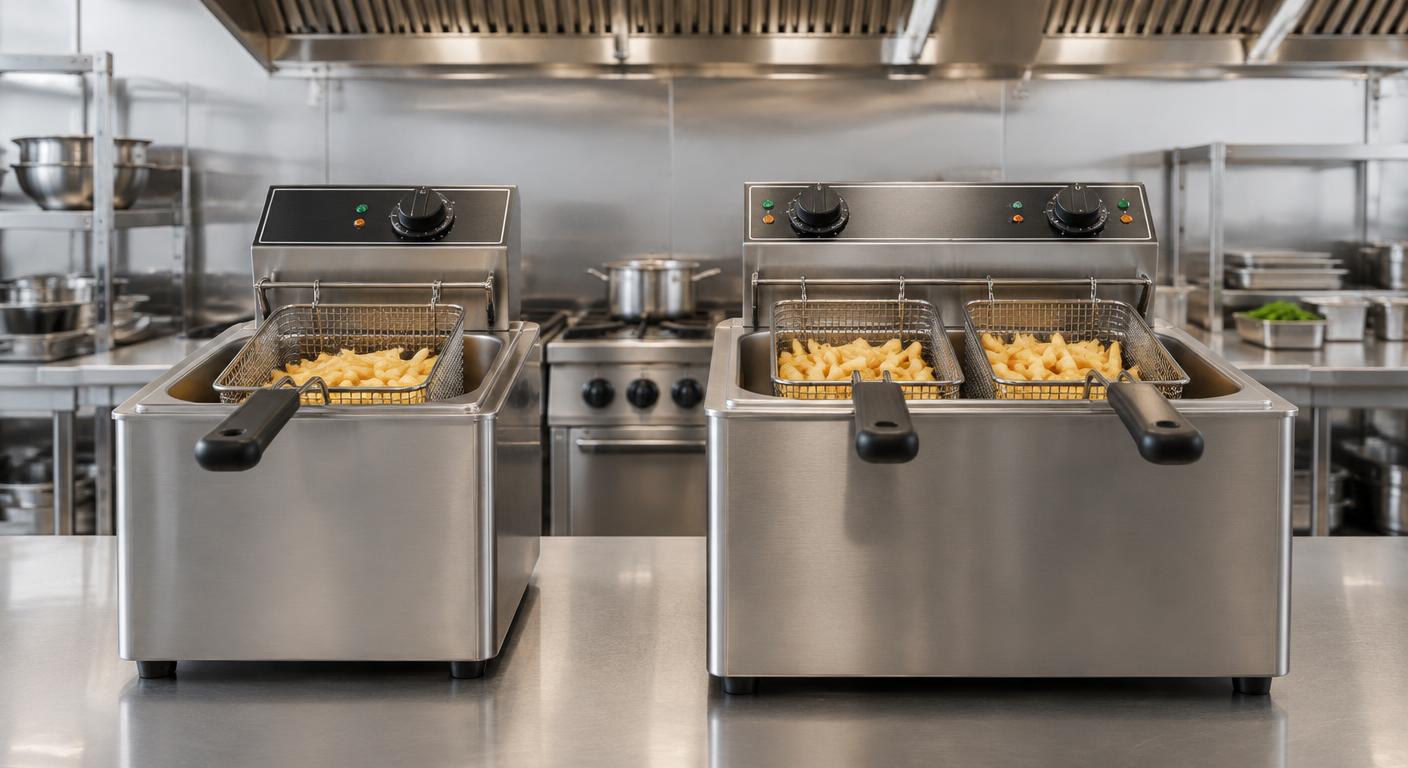
Choosing between a single vs twin basket deep fryer is really a decision about workflow, peak demand and menu flexibility—not simply how many baskets come with the machine.
A single-basket fryer can be the right choice for a restaurant with one main fried product and moderate demand. A twin-basket configuration becomes more useful when the kitchen needs to cook multiple batches simultaneously, separate products or increase output during busy service. Modern commercial fryers can also combine a full vat with two smaller baskets, so basket count and oil-vat configuration should be considered separately.
For a commercial deep fryer in Kenya, the best choice starts with one question:
How much fried food does the kitchen actually need to produce during its busiest period?
What is the difference between a single and twin-basket deep fryer?
A single-basket fryer uses one cooking basket at a time, while a twin-basket configuration allows two baskets to operate simultaneously, depending on the fryer design.
The important distinction is that two baskets do not necessarily mean two independent oil vats.
Some commercial fryers have a full-size vat that accommodates two smaller baskets. Others use genuinely split vats, where each side has its own oil supply and independent temperature control.
| Configuration | How it works | Best suited to |
|---|---|---|
| Single basket | One basket operating in a cooking vat | Lower-volume or simple menus |
| Two baskets, one full vat | Two smaller baskets share one oil vat | Higher simultaneous output |
| Split/twin vat | Two independent oil compartments | Different products, temperatures or oil separation |
| Multiple-vat fryer bank | Several vats combined in one station | High-volume restaurants and QSRs |
Commercial fryer manufacturers offer both full-vat and split-vat configurations because the operational requirements are different.
Is a twin-basket fryer better than a single fryer?
A twin-basket fryer is not automatically better; it is better when the kitchen needs simultaneous production, menu flexibility or greater peak-hour throughput.
For a restaurant selling mainly chips, samosas or one other consistently fried product, a single-basket configuration may be sufficient.
For a busy restaurant serving chips, chicken, fish, onion rings and other fried products, two baskets can help the kitchen run multiple batches without constantly waiting for one basket to become available.
The right decision should therefore be based on peak workload rather than the number of menu items alone.
Middleby recommends sizing a commercial fryer around the busiest service period, taking into account expected portions, batch size, frying time and recovery time.
When should you choose a single-basket commercial deep fryer?
A single-basket fryer is usually appropriate when the kitchen has moderate frying demand and a relatively simple frying operation.
It can make sense for:
- Small restaurants
- Cafés
- Takeaway businesses
- Bars and pubs with limited fried food
- Kitchens where fried products are secondary menu items
- Businesses with limited floor space
The major advantage is simplicity.
There is less equipment to manage, less oil being used when demand is low, and less complexity for staff.
A small operation does not benefit from buying industrial fryer capacity that sits unused for most of the day.
When should you choose a twin-basket deep fryer?
A twin-basket fryer becomes attractive when the kitchen regularly needs two batches cooking at the same time.
It is particularly useful when:
- Fried food represents a major share of sales
- Peak-hour demand is high
- Several fried products are ordered simultaneously
- Staff need shorter waiting times between batches
- The kitchen wants greater production flexibility
- One fryer station needs to handle several order tickets at once
A current commercial fryer example from Middleby offers a 40–50 lb full vat with the option of two twin baskets, allowing simultaneous cooking within the same fryer footprint.
That illustrates an important equipment-design principle:
Basket capacity and oil-vat capacity are not the same thing.
What is the difference between two baskets and a split-vat fryer?
Two baskets in one vat provide greater cooking capacity, while a split-vat fryer provides greater cooking separation.
This difference becomes important when the kitchen cooks products with different requirements.
Imagine a restaurant serving:
Basket/Vat A: French fries
Basket/Vat B: breaded chicken
If both baskets share the same oil, oil flavour transfer and product separation remain considerations.
With independently controlled split vats, the kitchen can maintain separate oil supplies and operate the two sides according to different cooking requirements.
Middleby's current commercial fryer guidance identifies split vats as particularly useful for mixed menus, flavour separation and operations that need to run different products at the same time.
So when comparing a single vs twin basket deep fryer, ask a second question:
Do I need more output, or do I need more separation?
Those are different requirements.
How much capacity does a commercial deep fryer need?
Fryer capacity should be based on the kitchen's required peak output, not simply the size of the restaurant.
The practical calculation starts with:
Peak portions per hour → portion weight → batch size → frying time → recovery time
For example, assume a restaurant expects to sell 180 portions of chips during its busiest hour.
If each portion contains 200 g of cooked product:
180 × 0.2 kg = 36 kg of cooked product per hour
That does not automatically mean the fryer needs a 36 kg oil capacity.
The kitchen must consider product load, oil-to-food ratio, actual batch size, frying time and temperature recovery.
This distinction is important because oil capacity is not the same as food throughput.
A fryer containing more oil is not automatically capable of producing proportionally more food.
The heating system's ability to recover cooking temperature after loading is also critical. Middleby's fryer guidance specifically identifies recovery under a real product load as an important performance factor.
Why is fryer recovery time important?
Recovery time is one of the most important specifications when selecting a fryer for a high-volume kitchen.
Recovery time is the period required for the oil to return to the target cooking temperature after food is added.
A fryer can have a large oil capacity and still become a production bottleneck if its heating system cannot recover quickly enough.
For example, imagine two fryers:
| Specification | Fryer A | Fryer B |
|---|---|---|
| Oil capacity | Large | Moderate |
| Batch size | Large | Moderate |
| Recovery | Slow | Fast |
| Peak service | Slows down | Maintains output |
The larger fryer is not necessarily the better fryer.
This is why the specification should be evaluated as a complete system:
Oil capacity + heating power + batch size + recovery + basket configuration
rather than by oil capacity alone.
What size industrial fryer does a high-volume kitchen need?
A high-volume kitchen needs enough fryer capacity and recovery performance to maintain production during its busiest service periods without creating a queue at the fry station.
Commercial floor fryers commonly come in substantially larger oil capacities than countertop models. For example, current commercial models include 40–50 lb full-vat configurations, while multiple-vat fryer banks can provide several times that total capacity.
However, there is no universal “correct” industrial fryer capacity.
A QSR selling thousands of fried portions has completely different requirements from a hotel kitchen that prepares fried food mainly during breakfast and dinner.
The fryer should therefore be sized around actual production requirements.
Does a stainless steel fryer make sense for a restaurant kitchen?
A stainless steel fryer is a practical choice for many commercial kitchens because the material can support durability, cleanability and a professional kitchen environment when properly fabricated and maintained.
However, stainless steel construction alone does not determine fryer quality.
The kitchen should also evaluate:
- Frypot construction
- Heating system
- Temperature controls
- Basket design
- Filtration
- Drain arrangement
- Service access
- Safety controls
- Available power or gas supply
- Manufacturer specifications
Current commercial electric fryers are available with stainless-steel tanks and cabinets, digital or solid-state controls, filtration systems and different vat configurations.
The specification should be matched to the kitchen rather than selecting equipment based solely on appearance.
Should a restaurant use one fryer for everything?
Not necessarily. Using one oil supply for every fried product can create quality and flavour problems when the menu contains products with significantly different characteristics.
Fish, strongly seasoned foods and heavily breaded products can introduce flavours or particles into the oil.
Middleby's current fryer selection guidance specifically highlights flavour separation as a reason to use dedicated vats for certain menus. It also notes that breaded proteins create greater sediment loads than relatively clean products such as French fries.
A restaurant serving a mixed menu should therefore consider whether it needs:
One high-capacity vat
or
multiple independent vats for product separation.
This decision can have a bigger operational impact than simply choosing between one or two baskets.
How does menu design affect fryer selection?
The menu should determine the fryer configuration.
Consider these three restaurants.
Restaurant A: Burger and chips concept
The majority of fried production is French fries, with a few additional sides.
A full vat with two baskets may provide an efficient balance of capacity and simplicity.
Restaurant B: Chicken and chips takeaway
Chicken is a major product, with high-volume frying during peak periods.
The kitchen needs to pay particular attention to batch size, recovery, sediment handling and fryer throughput.
Restaurant C: Mixed restaurant
The menu includes fries, fish, chicken, samosas and other fried products.
This operation may gain more from multiple or split vats because product separation and simultaneous production become increasingly important.
The same fryer cannot be optimal for all three businesses.
Why should peak-hour demand determine fryer capacity?
Peak-hour demand is more important than average daily demand because the fryer becomes a bottleneck precisely when orders arrive fastest.
Suppose a restaurant produces:
20 portions/hour during quiet periods
but
90 portions/hour during lunch
Sizing the fryer around the daily average could produce a system that looks adequate on paper but fails during the busiest hour.
A better approach is to identify the busiest 30–60 minute period and calculate the fryer workload during that window.
Middleby's current fryer-selection guidance uses this same peak-production principle and recommends working backward from peak portions, realistic batch sizes and recovery requirements.
The objective is not to maximize theoretical capacity.
It is to maintain real production capacity when the kitchen is under pressure.
How does oil filtration affect commercial fryer performance?
Oil filtration helps remove food particles and sediment that can degrade frying performance and oil quality.
This becomes particularly important in kitchens frying breaded foods.
Modern commercial fryers are available with integrated filtration systems. For example, current fryer models from major manufacturers include under-fryer filtration systems designed to remove debris from the cooking oil.
For a high-volume kitchen, filtration should therefore be evaluated alongside fryer capacity.
A useful specification comparison is:
Capacity + recovery + filtration + basket configuration
rather than capacity alone.
Single vs twin-basket deep fryer: which uses less oil?
A single-basket fryer will generally use less oil when its cooking vat is physically smaller, but basket count alone does not determine oil consumption.
A twin-basket fryer can operate two baskets in a single full-size vat, while a split-vat fryer can divide the oil between two independent compartments.
The more useful question is:
How much oil does the selected fryer require to operate correctly, and how much product does it process during your actual service?
For example, a current Frymaster FilterQuick model specifies 31 lb of oil for a full vat and 15.5 lb per side for its dual-vat configuration, demonstrating that split-vat systems divide the total oil volume differently from full-vat designs.
Actual capacity varies by model, so manufacturer's specifications should always be checked before purchase.
Which fryer is better for a small restaurant in Kenya?
A smaller restaurant should generally choose the simplest fryer that can comfortably handle its peak demand.
A single-basket or compact commercial fryer may be appropriate where fried food is a secondary part of the menu.
However, a small physical kitchen can still have high fryer demand.
A busy takeaway selling chicken and chips may require significantly more fryer capacity than a larger sit-down restaurant that sells only occasional fried sides.
The determining factor is therefore production volume, not restaurant floor area.
Which fryer is better for a high-volume restaurant?
A high-volume restaurant should prioritize throughput, recovery, oil management and the ability to cook multiple batches simultaneously.
That often makes twin baskets, multiple vats or a fryer bank more appropriate than a simple single-basket setup.
The final configuration should be matched to:
- Peak portions per hour
- Product mix
- Batch size
- Cooking times
- Recovery performance
- Oil separation requirements
- Available kitchen space
- Electrical or gas infrastructure
- Filtration requirements
For large operations, fryer selection should form part of the overall kitchen equipment layout rather than being purchased independently.
What should you check before buying a commercial deep fryer in Kenya?
Before selecting a fryer, prepare the kitchen's actual production requirements.
Check:
- What products will be fried?
- How many portions are expected during peak service?
- What is the average batch size?
- How long does each product take to cook?
- Do products need separate oil?
- How important is rapid recovery?
- What power or gas supply is available?
- How will used oil be drained and handled?
- Does the fryer include filtration?
- How much floor and service space is available?
The answer to these questions gives an equipment supplier or kitchen designer a much better basis for selecting the fryer.
A practical fryer selection example
Consider a Kenyan fast-casual restaurant selling:
- French fries
- Fried chicken
- Samosas
- Fish
- Onion rings
The kitchen expects its busiest period to generate a large proportion of the day's fried-food orders.
A single small fryer could technically cook all of these products, but the operational problem would be queueing.
The kitchen might need to finish fries while chicken is already cooking. Fish may also need separate oil to protect product quality.
In this scenario, a twin-basket configuration may improve simultaneous production, while a multi-vat or split-vat configuration could provide additional separation.
The most appropriate choice cannot be determined from the menu alone. Peak quantities, batch size, frying time and the manufacturer's performance specifications must be considered.
This is the critical difference between buying a fryer and designing a frying station.
How should the fryer fit into the commercial kitchen layout?
The fryer should be positioned as part of the cooking line and coordinated with extraction, preparation, refrigeration, landing space and service flow.
A commercial fryer generates significant heat and, depending on the cooking process, grease-laden vapour. It therefore needs to be considered alongside the kitchen's exhaust hood and ventilation system.
The fryer also needs safe access for:
- Loading baskets
- Removing cooked food
- Draining oil
- Cleaning
- Filtering
- Maintenance
The equipment footprint on a plan is only the beginning.
The designer should also consider how a cook actually works around the fryer during a busy service.
A fryer surrounded by poorly placed refrigeration, preparation tables or passing traffic can become an operational bottleneck even when its technical capacity is correct.
The biggest mistake when choosing a commercial fryer
The biggest mistake is choosing a fryer based on its advertised capacity rather than the kitchen's actual peak production requirements.
A fryer might have a large oil capacity but poor recovery.
A twin-basket fryer might provide simultaneous production but not the separation the menu requires.
A compact fryer might fit the kitchen perfectly but become overwhelmed during the lunch rush.
And an expensive industrial fryer can still be the wrong investment if most of its capacity is never used.
The correct decision is therefore:
Menu → Peak demand → Batch requirements → Recovery → Vat configuration → Basket configuration → Utilities → Kitchen layout
That sequence prevents the fryer from becoming an expensive bottleneck.
Common Questions
Planning a commercial kitchen or bakery?
EMOST fabricates and installs complete commercial kitchens across Kenya — from deck ovens and prep tables to extraction hoods and full cooking lines. Get an itemized quote before you order.